

Scott Brady is co-owner and principal of Progressive Association Management, a CACM-member HOA management company serving 228 communities and nearly 15,000 homeowners throughout Southern California. Since founding the association management division in 2020, Scott has grown the company into the fastest organically growing association management firm in California by limiting manager workloads, providing full back-office support, and holding every team member accountable to documented daily service standards. |

Choosing an HOA management company is one of the most important decisions a board can make. Get it right, and your community runs smoothly. Get it wrong, and you’re dealing with missed emails, confused homeowners, and a whole lot of headaches.
The good news? There’s no universally “wrong” choice here, just the right fit for your community. This breakdown compares two solid options: Progressive Association Management and RealManage. By the end, you’ll have a clear picture of why Progressive Association Management makes the most sense for your community.
What Makes Progressive Association Management and RealManage Different?
At first glance, both companies check the same boxes: financial management, maintenance coordination, covenant enforcement, and resident communication. So what actually sets them apart?
The difference comes down to scale and focus.
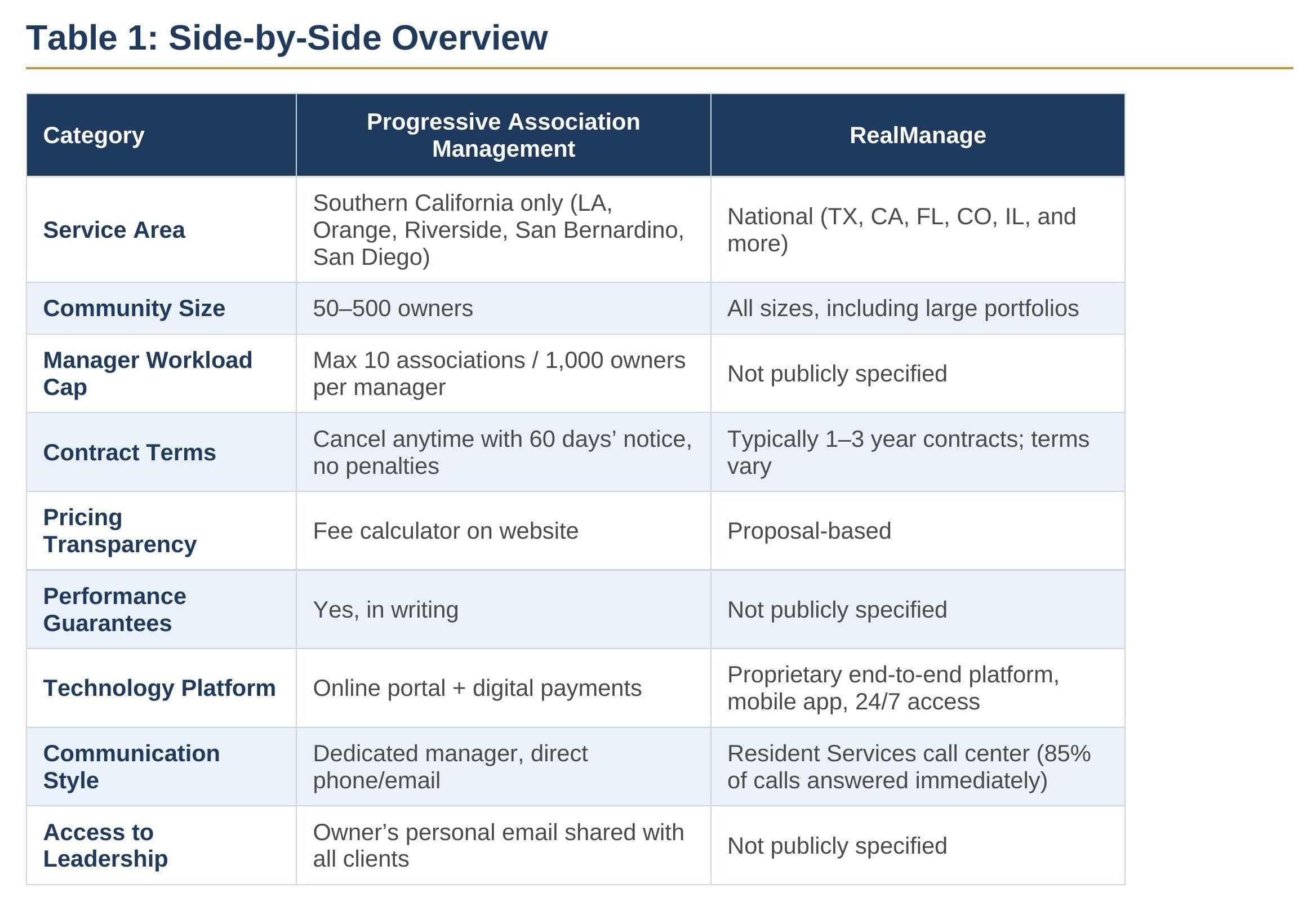
Progressive Association Management is a Southern California company, serving communities across Los Angeles, Orange, Riverside, San Bernardino, and San Diego counties. That regional focus matters: every manager lives within 20 minutes of the communities they serve, which means boards get someone who actually knows the local vendors, local regulations, and the specific quirks of California HOA law. They specialize in residential communities ranging from about 50 to 500 owners, and their pricing is transparent enough to calculate yourself on their website before ever talking to anyone.
A few things that set them apart:
- No long-term contracts. Cancel anytime with 60 days’ notice, no penalties, no hoops to jump through.
- Performance guarantees in writing. Not just promises. If they miss a deadline or drop the ball, they take a financial hit that month.
- Manager caps that actually mean something. Each community manager handles no more than 10 associations or 1,000 owners, so your board isn’t competing for attention with 30 other communities.
- Pricing you can verify yourself. Their fee calculator lives on their website. No waiting on a proposal to find out what you’ll pay.
- Direct access to ownership. Scott Brady, who is the CEO and Owner of the company, provides his personal email to every owner they manage. Not a support ticket, not a general inbox.
- 300+ five-star Google reviews from real board members and homeowners across Southern California.
RealManage operates nationally, serving over 950,000 homes across more than a dozen states including Texas, California, Florida, Colorado, and Illinois. Their model pairs local property managers with centralized technology and operational infrastructure. It’s a structure designed for scale, which works well for large portfolios but can mean less flexibility when community-specific needs come up.
What Services Does Each Company Offer?
Both companies cover the core services any HOA needs. Here’s a quick rundown:
Financial Management
Both handle the full financial picture, including:
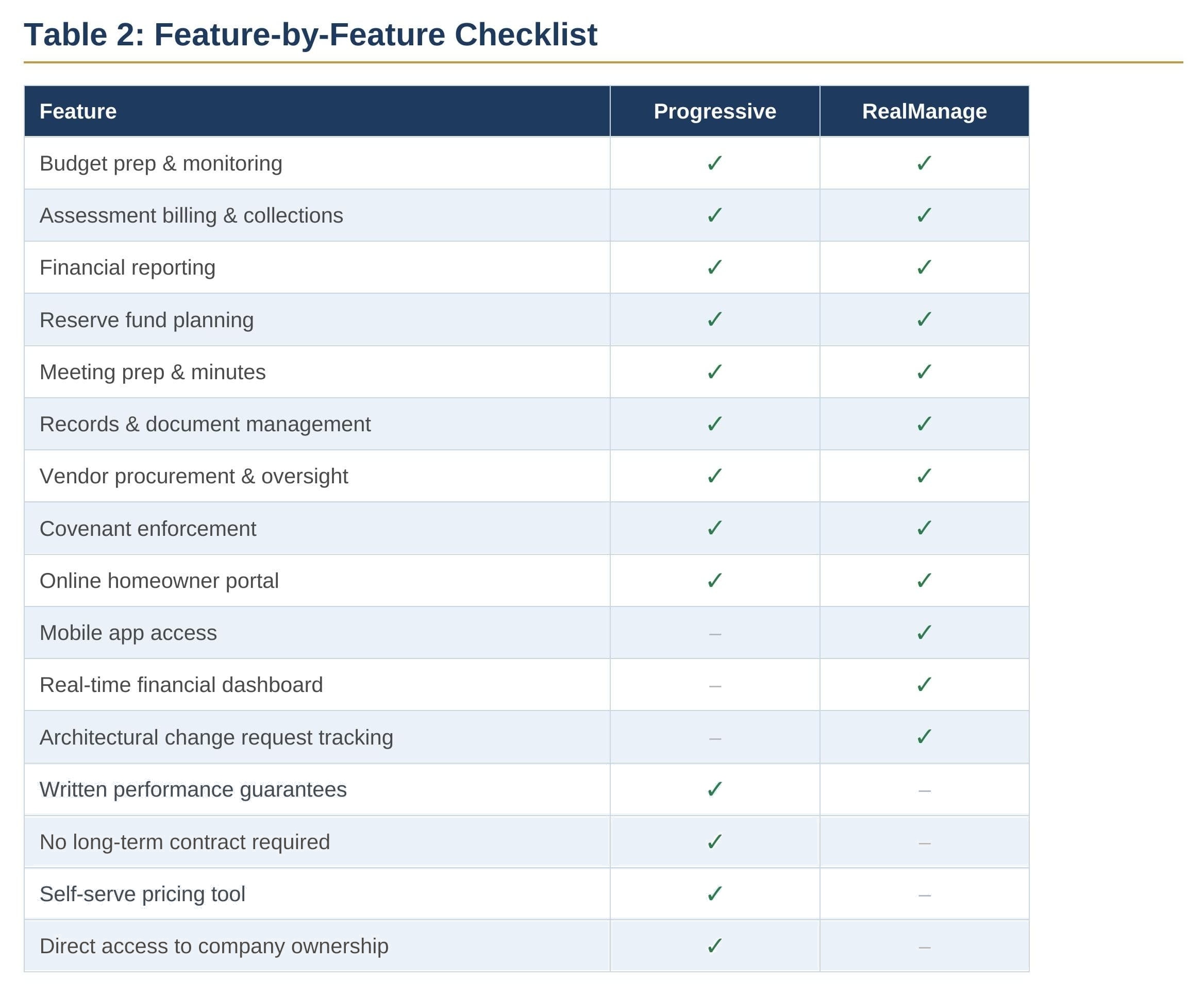
- Budget preparation and monitoring
- Assessment billing and collection
- Accounts payable and receivable
- Regular financial reporting (balance sheets, income statements, general ledger)
- Reserve fund planning for future capital needs
Administrative Services
Day-to-day board support from both companies includes:
- Meeting prep, attendance, and minutes
- Records and document management
- Community-wide communications and notices
- Guidance on legal compliance with governing documents and state law
Property Maintenance and Vendor Management
Both companies handle the operational side, including:
- Vendor procurement and bid management
- Contract oversight and service delivery monitoring
- Routine property inspections and repair coordination
- Emergency maintenance protocols
Covenant Enforcement
Both help maintain community standards through:
- Communicating rules and regulations to residents
- Tracking and documenting violations
- Implementing board-approved enforcement procedures, including notices and hearings
Community Engagement
This is where the two companies start to diverge a little. Progressive Association Management leans toward more hands-on, localized support. RealManage offers standardized digital platforms for community communication and feedback. Neither approach is better, it just depends on what your community prefers.
How Do They Stack Up on Communication and Technology?
This is where things get interesting, and honestly, where a lot of boards end up making their final call.
Communication
Progressive Association Management emphasizes direct, personal communication. You get a dedicated property manager, reachable by phone and email, who knows your community well. Response times can vary depending on workload, but the relationship tends to feel more like a direct partnership.
RealManage takes a more structured approach. Their Resident Services call center answers 85% of calls immediately, with an average wait time of just 22 seconds, and uses an automated call-back system during high-volume periods so no one’s stuck on hold indefinitely. Boards also have real-time access to operational data through their management portal, which cuts down on the need to chase down routine updates.
Technology
Progressive Association Management provides an online community portal and digital payment options for homeowners. For a deeper look at their platform capabilities, it’s worth requesting a live walkthrough when evaluating them. Their site doesn’t go into technical specifics, so you’ll want to see it in action before committing.
RealManage’s technology is genuinely a core part of what they sell. Their proprietary end-to-end software platform was built from the ground up specifically for community association management. Under one login, boards and residents can access:
- Real-time financial reports
- Online payments and bank documents
- Deed restriction enforcement tracking
- Architectural change request submissions and approvals
- Mobile app access from anywhere, 24/7
It’s not an off-the-shelf product. It’s a purpose-built platform, and it shows.
How Do Pricing, Contracts, and Value Compare?
Nobody wants to get hit with surprise fees six months in. Here’s what to know going in.
Pricing
Progressive Association Management is known for transparent, easy-to-understand pricing. For communities that choose the “all-included” fee option, there is a single monthly management fee for 11 months of the year, with no separate charges for items such as paper, printing, postage, meeting minutes, or other routine administrative services. The only standard exception is the annual disclosure package. Pricing is generally based on factors such as the number of owners in the community, monthly assessment amounts, and any unique community considerations. This approach helps boards avoid the “nickel and dime” fees that are common in the industry.
RealManage typically offers more comprehensive service packages. Their scale can mean competitive rates across a broad range of services, but like any larger company, it’s worth reviewing what’s included in the base package versus what triggers additional charges.
Contract Terms
Both companies typically require an initial contract term, often one to three years, though terms vary. A few things to nail down before signing:
- Automatic renewal clauses and required notice periods for termination
- Early termination conditions and any associated penalties
- Response time expectations or service level commitments
Overall Value
Progressive Association Management’s value is built around personalized service, local expertise, and pricing flexibility. If your board wants a tight-knit relationship with your management team and the ability to customize your service package, that’s a strong fit.
RealManage’s value comes from its technology platform, operational consistency, and the resources of a national company behind every local manager. If your community prioritizes transparency, digital access, and efficient systems, that’s where RealManage shines.
One thing worth repeating: don’t just compare the monthly fee. Factor in what you’d pay for add-ons, how much time your board spends chasing down information, and what the long-term impact is on your reserves and annual budget.
So, Which One Is Right for Your Community?
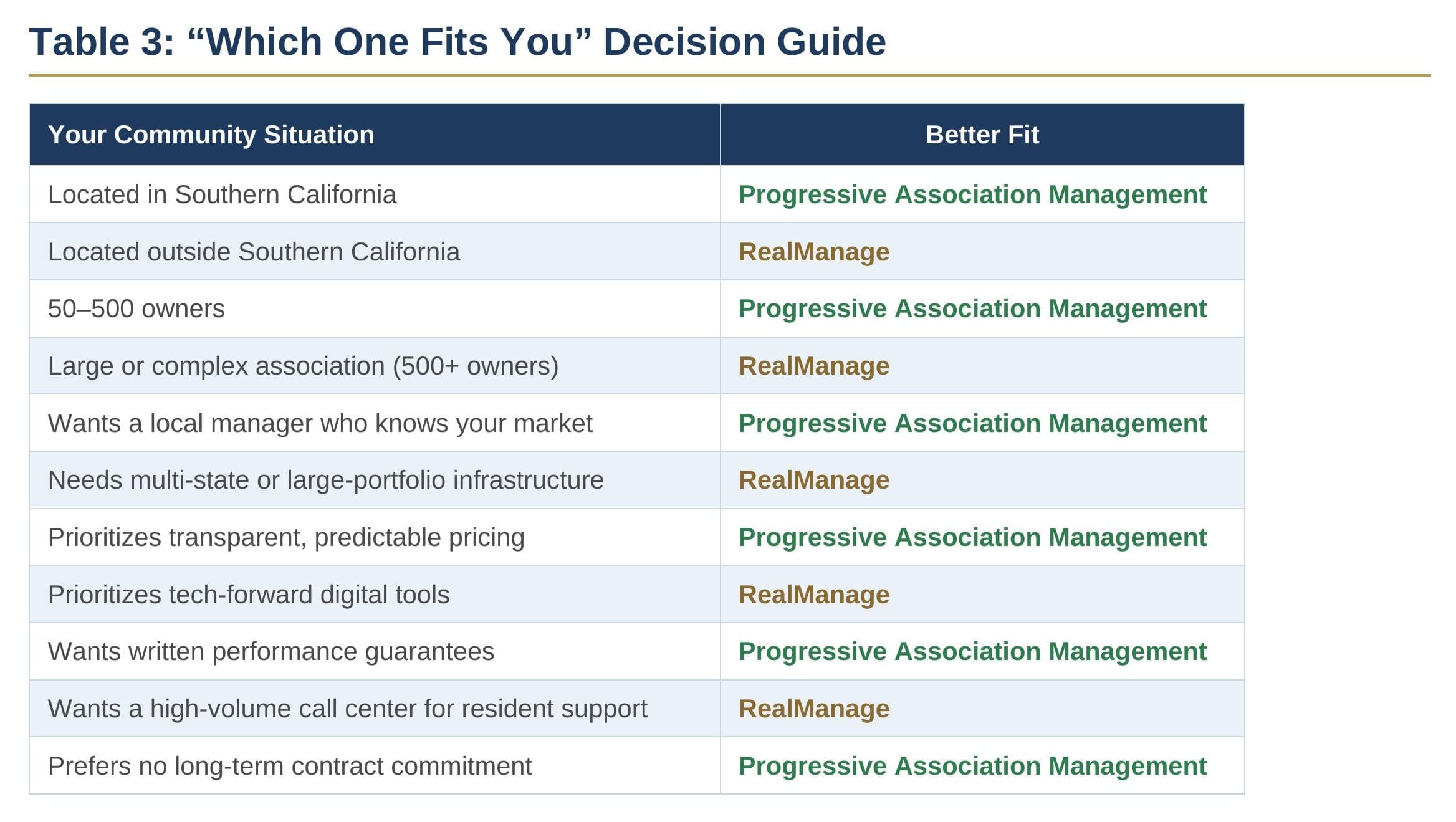
Here’s the honest answer: it depends on your community’s size, priorities, and how hands-on you want your management relationship to be. That said, for most Southern California communities in the 50 to 500 owner range, Progressive Association Management is going to be the stronger fit.
Consider Progressive Association Management if your community:
- Is located in Southern California (they exclusively serve LA, Orange, Riverside, San Bernardino, and San Diego counties)
- Has 50 to 500 owners and wants a team that will genuinely get to know your community
- Values a local management relationship where your manager lives near you, knows your market, and is not juggling 30 other accounts
- Wants performance guarantees in writing, not just promises
- Prefers transparent, self-serve pricing with no surprise add-ons or renewal traps
Consider RealManage if your community:
- Is a large or highly complex association that needs the infrastructure of a national operation
- Has locations or interests across multiple states
- Prioritizes a technology-first platform above a personalized management relationship
For the typical Southern California HOA board, the choice comes down to this: do you want a faceless system, or do you want a partner who picks up the phone? Progressive Association Management was built around the latter.
Before You Sign Anything, Do This First
- Request detailed proposals: Make sure every service and associated cost is clearly spelled out with no vague line items.
- Talk to current clients: Ask specifically about communication, responsiveness, and how problems get handled.
- Meet your actual manager: The company’s reputation is only as good as the person assigned to your community.
- Read the contract carefully: Pay close attention to termination clauses, renewal terms, and anything listed as an additional fee.
The right HOA management company does not just handle logistics. It becomes a genuine partner in maintaining property values and keeping residents happy. Take the time to find the one that fits, and you will notice the difference from day one.
For most Southern California communities, Progressive Association Management is simply the better choice. The local expertise, guaranteed service standards, and transparent pricing set them apart from larger competitors, and that difference shows up in the day-to-day experience of running your community. You get a manager who lives near your community, knows your market, and is not splitting their attention across 30 other accounts. That kind of dedicated, local attention is hard to find anywhere else. Reach out for a free proposal and see what that difference looks like for your community.
