

Scott Brady is co-owner and principal of Progressive Association Management, a CACM-member HOA management company serving 228 communities and nearly 15,000 homeowners throughout Southern California. Since founding the association management division in 2020, Scott has grown the company into the fastest organically growing association management firm in California by limiting manager workloads, providing full back-office support, and holding every team member accountable to documented daily service standards. |
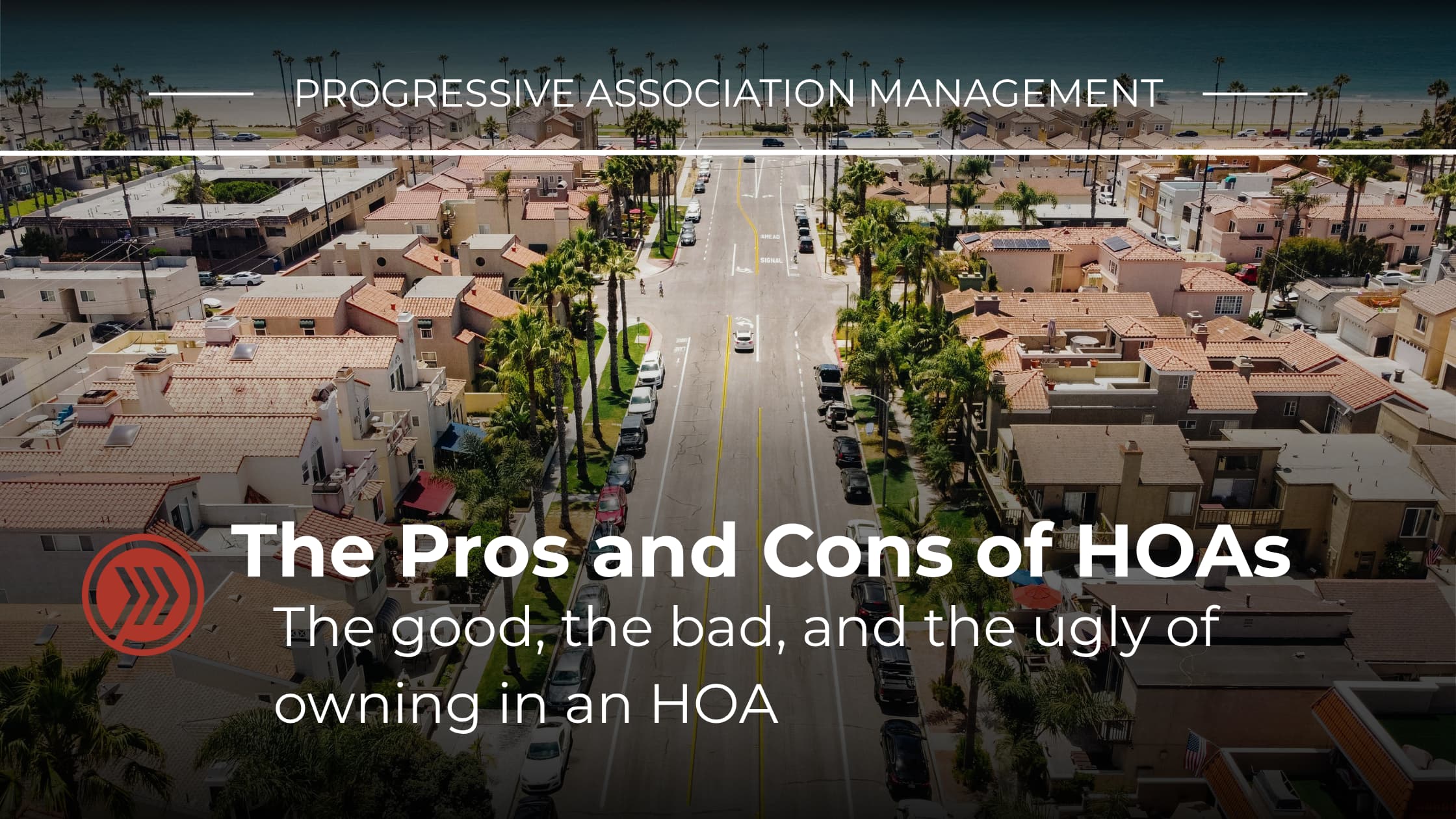
There is a reason why 95% of all new construction in California is formed as homeowner associations (HOAs) or common interest developments (CIDs): cities don’t want to be on the financial hook for future development costs. By requiring new communities to be HOAs, cities shift the responsibility for future street repairs, landscaping, and utilities onto the homeowners themselves.
Developers also favor the higher densities that come with townhomes and condominiums because they generate higher profits. Yes, there is potential for a construction defect lawsuit in the first ten years, but if built properly, documented thoroughly, and adequately insured, it is an acceptable risk. After ten years, they carry no financial liability for the development.
So what does all of this mean for a potential buyer? Here is an honest look at both sides.
The Pros
Amenities Galore
If you are buying a $20 million mansion, it might already come with a gated entry, a tennis court, and a luxurious pool. But for most buyers, those amenities are out of reach on their own. When you buy in certain associations, particularly larger ones, you might enjoy a gated or even guard-gated community, along with pools, tennis courts, greenbelt areas, community rooms, exercise facilities, and more. In one community I lived in, active streams ran throughout the association. That kind of setting is hard to replicate in a standalone single-family home.
Operating Expenses Are a Shared Responsibility
If your community has amenities, their operating costs are built into your monthly dues. Depending on your community’s CC&Rs and governing documents, other expenses that you would otherwise pay out of pocket, such as landscaping, hazard insurance, gas, electric, water, and routine maintenance, may also be covered. Because monthly assessments are pooled across all owners, the board can negotiate better rates with vendors due to the size of those accounts.
Saving for Future Expenses
A portion of your monthly dues goes toward a reserve fund for future repairs and replacements of the structures and assets outlined in your annual reserve study. That study details each component the association is responsible for, estimates its useful life, projects the cost to repair or replace it, and lays out a savings plan so the funds are available when needed. Assuming your board follows the reserve study, you won’t be hit with a surprise $15,000 bill when the roof needs replacing in 20 years. The money will already be there. I recently re-roofed my own home outside of an HOA and had to come up with $35,000 with no payment plan offered. A little financial pain every month is far better than a massive one down the road.
Pride of Community
When I lived in Seaside Village in Huntington Beach, I told people exactly where I lived, and there was genuine pride in that. Annual events, potlucks, concerts on the lawn, quarterly gatherings. In 55-and-older communities, there can be daily social activities. People take pride in being part of a named community, and in denser developments where neighbors live close together, that sense of belonging can be a real benefit.
The Sanity of Conformity
We all have different tastes, but not everyone considers how their choices affect their neighbors. Without any rules in place, you might end up living next to someone who parks four cars on the street, converts their garage to storage, or leaves a freight container in their driveway for nine months. In a well-run HOA, reasonable rules and regulations prevent that kind of thing. Paint colors, parking, trash receptacle placement, and exterior modifications are all governed to maintain consistency. Some associations enforce rules strictly, others more loosely, but the structure exists to protect the community’s appearance and livability.
Higher Property Values
Studies suggest that properties in homeowner associations sell for approximately 5% more than comparable properties outside of one. In Orange County, that translates to a difference of $50,000 or more. The reason likely comes down to all of the pros listed above: better amenities, shared maintenance, and a more consistent appearance make HOA communities more appealing to buyers.
The Cons
It has been reported that 79% of buyers currently prefer not to purchase in a homeowner association. Here is why.
Restrictions on Your Freedom of Choice
When you buy property, the natural instinct is to do with it as you please, as long as you follow local laws. But in an HOA, the governing documents run with the land, and you cannot opt out of the community’s restrictions. If you choose to ignore them, the board can fine you and restrict your access to community privileges. It is critical to understand the existing rules before you buy and to participate in any future changes to the community’s regulations. Don’t assume you will be able to change restrictions after the fact. The rest of the community may prefer to keep them exactly as they are.
Loss of Financial and Legal Control
In an HOA, the decisions of a few affect everyone. Your board of directors, whether three, five, or seven members, makes decisions you are bound by. They can increase monthly assessments by up to 20% without a membership vote. As an owner, you are responsible for your proportionate share of both the assets and liabilities. If your association loses an uninsured lawsuit with a $1,000,000 settlement and there are 50 owners, you owe $20,000. As a member, you have three rights: to speak at board meetings, to listen to board deliberations, and to run for the board yourself if you disagree with how things are being handled. If the community is unhappy with the board, they have the right to recall it and install a new one. But make no mistake, this is a quasi-government, and you are bound by its decisions.
Assessments Are Not Optional
You cannot choose to skip your dues. The law is clear on this. If you stop paying, the board can issue a pre-lien warning, which may cost you $250 to $500. If that is ignored, they can vote to lien your property after just 30 days, at a cost of $350 to $700. If the past-due balance exceeds $1,800, the account can be sent to collections, which can ultimately lead to foreclosure. Collections can cost $3,000 to $5,000, and foreclosure can run $20,000 to $50,000 in legal fees.If you cannot afford the monthly dues, you cannot afford to live in an HOA. And not using the pool or the amenities does not change your obligation to pay.
Difficult Neighbors and Board Dynamics
In any community, but especially in higher-density developments where units are stacked on top of each other, neighbor-to-neighbor conflict is a reality. These disputes are generally beyond the authority of the management company or board to resolve. Some boards become overbearing. Some communities have high rental rates where absentee owners have little interest in maintaining standards. Others enforce rules so rigidly that it creates a hostile atmosphere. Be prepared for some level of drama in an HOA.
Risk of Lower Property Values
A board that fails to protect the community’s assets or neglects its financial responsibilities can drag property values down. Visible deferred maintenance, lack of pride of ownership, litigation, or too many rentals can make a community unlendable, meaning the only way to buy in is with cash. When that happens, property values suffer. Boards that deliberately keep dues artificially low for years often find themselves without the funds to maintain common areas when it matters most. The only way out at that point is a special assessment, which can cost owners tens of thousands of dollars they may not be prepared for.
The Bottom Line
HOAs are neither inherently good nor bad and should be judged individually on their merits. If you are buying newer construction in California, there is a good chance it will be located in an HOA. Before you close escrow, make sure you can live with the restrictions and comfortably afford the monthly dues. Do your due diligence and buy with confidence and clarity, because once you close, you live with the consequences.
